Why ILMT quietly dies
Nobody switches ILMT off. It degrades. Four mechanisms do most of the damage, and none of them raises an alert.
Agents stop reporting
A firewall rule change, a new proxy, a network segmentation project: any of these can cut BigFix agents off from the server. The host still shows in the console, only the last report date keeps getting older. The same kind of change breaks VM Manager connections: after a vCenter password rotation the hypervisor credentials stop working, and sub-capacity counting stops with them.
Software scans stop completing
An agent can report as alive while its software scans keep failing. A full filesystem, a crashed CIT scanner, a scan schedule someone paused during a maintenance window: the scan health view shows all of it, but only if someone opens it. Reports built on stale scan data look complete and are not.
The catalog and classification drift
IBM ships software catalog updates on a regular cycle, and new software versions land in ILMT as new detections. If nobody classifies them, they sit in the queue for months and either inflate your PVU numbers or hide products that should be counted. Bundling decisions do not make themselves.
Operating systems fall out of sub-capacity
Sub-capacity licensing only covers eligible platforms. When an operating system reaches end of support, or a virtualization stack drops off IBM's eligibility list, those hosts quietly flip to full-capacity counting. On a large VMware cluster that difference is not small, and older ILMT versions will not warn you: end-of-eligibility reporting for operating systems only arrived in 9.2.42.
The deliverable: a quarterly audit-ready package
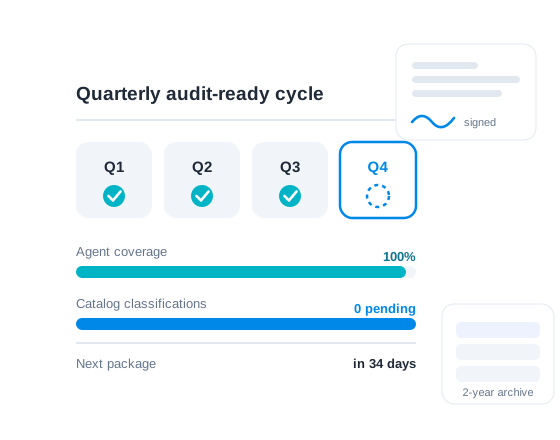
IBM's sub-capacity terms are specific: you generate reports at least once a quarter and you keep them for two years. When the audit letter arrives, what counts is what you can put on the table. So the core deliverable of this service is a package, produced every quarter, that you can put on the table.
Quarterly Audit-Ready Package
- A signed quarterly compliance report: your license position per product, reviewed and signed off, not just exported.
- An archive of audit snapshots, stored so the two-year history IBM expects actually exists.
- A discrepancy list with recommendations: what changed, what does not add up, and what to do about it.
Three packages
ILMT Review
- Quarterly review of your ILMT environment
- Agent and scan health check
- Quarterly Audit-Ready Package
ILMT Care
- Everything in Review
- Monthly monitoring
- Agent and scan repair
- Catalog updates and classification of new detections
- Email support, next-business-day response
ILMT Complete
- Everything in Care
- Full ILMT and BigFix administration
- Server upgrades and VM Manager
- Infrastructure changes
- Handling IBM inquiries
- Priority during an audit
Billing is a flat monthly fee based on the size of your environment: the endpoint count and the number of Passport Advantage sites. If ILMT needs fixing before it can be maintained, I start with an ILMT Health Check and credit its cost against your first quarter of care.
Not sure which package fits?
Thirty minutes on a call is usually enough to tell. Bring your endpoint count and the date of your last audit snapshot, if you know it.
Book a 30-minute callWho this is for, and who it is not
This service fits organizations with 100 to 2000 endpoints, IBM software in the portfolio, and no full-time ILMT specialist. That is what most of the environments I see look like: someone owns ILMT on paper, nobody owns it in practice.
It is not for environments that want a one-time fix. If you need ILMT repaired before an audit and nothing more, the ILMT Health Check is the right service.
One more thing worth knowing: ILMT Consulting is one person, and that person is me. My name is Tomasz Oniśk. I have worked with ILMT and BigFix since 2014 and have run an independent practice since 2020, with around 30 organizations behind me in finance, insurance, energy and the public sector. The same person looks at your environment every quarter, not a rotating support team. That is also why the number of clients I take on is limited. For larger projects I can bring in a few trusted independent specialists I have worked with for years.
What this looks like in practice
A bank in Poland
Situation: years without maintenance. 8 of 11 ILMT agents were not reporting, and 3 hosts had no hypervisor data, so their PVU counts could not be trusted.
What I did: repaired the agents and the missing hypervisor data, upgraded the ILMT server from 9.2.7 to 9.2.21, then moved the environment to ongoing care.
Result: maintenance now takes 3-4 hours a month in practice, with audit snapshots generated and archived every quarter.
A central bank
Situation: an institution that wants to know its IBM license position on an ongoing basis, not reconstruct it before an audit.
What I did: quarterly license balances, quarter after quarter, for 3 years.
Result: in one of those quarters the balance showed a 10 PVU shortfall on WebSphere. It was corrected before it grew into a problem. That is what a quarterly cycle is for: small findings stay small.